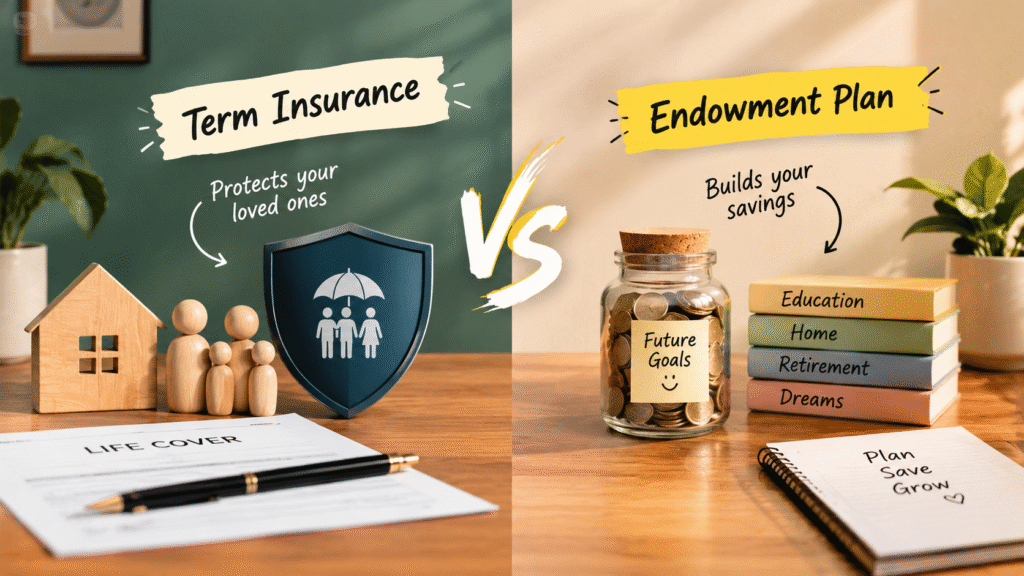
Choosing the right life insurance policy can feel confusing, especially when you come across options that promise financial protection as well as savings. Two popular choices are term insurance and endowment plans. While both offer life insurance coverage, they serve different financial needs. Understanding term insurance vs endowment plan can help you decide whether your priority is protecting your family’s future, building savings, or balancing both.
Imagine being the primary earner in your family. You want to make sure your loved ones can manage household expenses, loan repayments, and future goals even if you are no longer around. At the same time, you may want to save money for your child’s education, a house, or retirement. This is where choosing the right policy becomes important.
Let’s explore how these two plans work, their benefits and limitations, and which one may suit your financial goals.
What Is Term Insurance?
Term insurance is a type of life insurance that provides financial protection for a specified period, such as 20, 30, or 40 years. If the insured person passes away during the policy term, the insurer pays the agreed death benefit to the nominee, subject to the policy’s terms and conditions.
The main purpose of term insurance is to provide substantial financial protection at a relatively affordable premium. It is particularly useful for people who have dependants, outstanding loans, or long-term financial responsibilities.
Benefits of Term Insurance
High life cover: You can generally obtain a larger sum assured for a lower premium than with a comparable traditional savings-oriented life insurance policy.
Financial security for your family: The payout can help cover everyday expenses, education costs, outstanding debts, and other financial commitments.
Affordable premiums: Pure term plans typically offer substantial coverage without including a maturity savings benefit.
Flexible policy options: Depending on the insurer and product, you may be able to choose different policy terms, premium payment periods, and payout structures.
Limitations of Term Insurance
A pure term insurance policy generally does not pay a maturity benefit if the insured person survives the policy term. This means you should not purchase it expecting to receive your premiums back at the end.
Some policies offer a return-of-premium option, but these usually cost more than comparable pure term plans. Always check the product terms before making a decision.
What Is an Endowment Plan?
An endowment plan is a life insurance product that combines life cover with a savings component. It is designed to provide a death benefit if the insured person dies during the policy term or a maturity benefit if the policyholder survives until the policy matures, subject to the policy conditions.
Depending on the product, an endowment plan may offer guaranteed benefits, bonuses, or a combination of both. Bonuses are not necessarily guaranteed, so it is important to distinguish between guaranteed benefits and projected returns.
For people who prefer a structured savings approach alongside life insurance, an endowment plan may be worth considering.
Benefits of an Endowment Plan
Insurance and savings together: The plan combines life protection with a maturity-oriented savings feature.
Disciplined saving: Regular premiums can encourage you to set aside money consistently over several years.
Maturity benefit: If you survive the policy term, you may receive a maturity payout according to the policy conditions.
Potential bonuses: Participating plans may offer bonuses, depending on the insurer’s performance and declared bonuses.
Long-term goal planning: The maturity proceeds may help fund planned expenses such as education, a major purchase, or other future needs.
Limitations of Endowment Plans
Endowment plans generally provide less life cover per rupee of premium than pure term insurance. This can be a disadvantage if your primary objective is protecting dependants against the financial consequences of your death.
They may also require long-term premium commitments. Surrendering a policy early can result in lower-than-expected proceeds, and the actual returns may be less attractive than anticipated. Review the benefit illustration, surrender conditions, charges, and guaranteed versus non-guaranteed benefits before buying.
Term Insurance vs Endowment Plan: Key Differences
Although both products provide life insurance, their main objectives are different. Term insurance focuses on protection, while an endowment plan combines protection with savings.
| Feature | Term Insurance | Endowment Plan |
|---|---|---|
| Primary purpose | Financial protection | Protection and savings |
| Life cover | Generally higher for the same premium | Generally lower for the same premium |
| Premium cost | Usually lower for pure term cover | Usually higher for comparable life cover |
| Maturity benefit | Generally none under a pure term plan | Usually available if policy conditions are met |
| Savings component | No, under a pure term plan | Yes |
| Returns | No investment or maturity return under a pure term plan | Depends on guaranteed benefits, bonuses, and policy terms |
| Best suited for | People prioritising family protection | People seeking insurance with structured long-term savings |
| Early exit | Depends on the product; pure term cover usually has no surrender value | Early surrender may reduce the amount received |
The right choice depends on what you want your money to accomplish. A larger life cover may be more important when your family depends on your income, while a maturity benefit may appeal to someone who wants a combined insurance and savings product.
Term Insurance vs Endowment Plan: Which Is Better for You?
There is no single answer that works for everyone. Your income, dependants, existing savings, liabilities, and financial goals should guide your decision.
Choose Term Insurance If Your Priority Is Family Protection
Term insurance may be a suitable choice if you are the main earning member of your household, have a home loan, support your parents, or need to secure your children’s future.
For example, a young professional with a spouse, children, and a home loan may need substantial life cover to replace future income. A pure term plan can help provide that protection without requiring the higher premiums associated with many savings-linked policies.
You can then consider separate investments, such as mutual funds or other suitable financial products, based on your goals, time horizon, and risk tolerance. Remember that investments carry different risks and should not be treated as guaranteed substitutes for insurance benefits.
Choose an Endowment Plan If You Prefer Structured Savings
An endowment plan may suit someone who values regular saving and wants a policy with a defined maturity benefit. It can be appealing if you prefer a more structured approach and understand the long-term premium commitment.
However, do not choose an endowment plan simply because it promises a payout at maturity. Compare the total premiums, life cover, guaranteed maturity amount, projected bonuses, liquidity, and potential returns before committing your money.
If you need substantial protection for your family, check whether the life cover offered by the plan is sufficient for your actual needs.
Can You Have Both Term Insurance and an Endowment Plan?
Yes. You do not necessarily have to choose only one. Depending on your budget and financial circumstances, you can use term insurance for family protection and consider an endowment plan separately for structured savings.
For instance, a person with significant financial responsibilities might prioritise adequate term cover first. If their budget allows and an endowment plan fits their goals, they could consider it as an additional product.
The key is to avoid compromising essential life cover merely to obtain a maturity payout. You should also maintain an emergency fund and review other financial priorities before locking money into a long-term policy.
Factors to Consider Before Buying a Life Insurance Policy
Before making your final decision, review these important points:
1. Calculate Your Required Life Cover
Consider your family’s living expenses, outstanding loans, future education costs, and other financial obligations. Account for existing assets and insurance coverage to estimate an appropriate level of protection.
2. Compare Premiums and Benefits
Look beyond the premium amount. Compare the death benefit, maturity benefit, policy duration, exclusions, riders, and payment conditions across suitable policies.
3. Understand Guaranteed and Non-Guaranteed Returns
For an endowment plan, identify which benefits are guaranteed and which depend on future bonuses. Do not assume illustrated benefits are assured payouts.
4. Check Your Long-Term Affordability
Choose a premium that fits your budget over the required payment period. Missing premiums or surrendering a policy early may affect your benefits.
5. Review Policy Conditions Carefully
Read the policy document, including exclusions, grace periods, surrender rules, and claim requirements. Provide accurate information about your health, occupation, and lifestyle when applying for cover.
Common Mistakes to Avoid When Choosing Between These Plans
One common mistake is buying life insurance based only on tax benefits or the promise of receiving money at maturity. Tax treatment depends on applicable laws and the policy’s eligibility, so it should not be the only reason for purchasing a plan.
Another mistake is assuming that an endowment plan automatically provides enough protection. A maturity benefit does not necessarily mean the death benefit is adequate for your family.
Similarly, purchasing term insurance without estimating your coverage needs can leave your dependants underprotected. Take time to calculate your requirements and compare policies rather than relying solely on recommendations or advertisements.
Final Verdict: Which Life Insurance Plan Should You Choose?
The choice between term insurance and an endowment plan comes down to your priorities. If your main goal is to protect your family’s financial future with substantial life cover at an affordable premium, pure term insurance is often the more suitable starting point.
If you prefer a combination of life insurance and structured savings with a maturity benefit, an endowment plan may be worth evaluating. Its suitability depends on the benefits, premium commitment, liquidity, and returns offered by the specific policy.
Ultimately, good financial planning is not about selecting the product with the most attractive promise. It is about choosing a policy that fits your responsibilities, budget, and long-term goals.
At Growease Insurance Brokers Private Limited, you can seek guidance on understanding life insurance options and comparing policies based on your needs. Take the time to review your requirements, understand the terms, and make an informed decision that supports your family’s financial security.