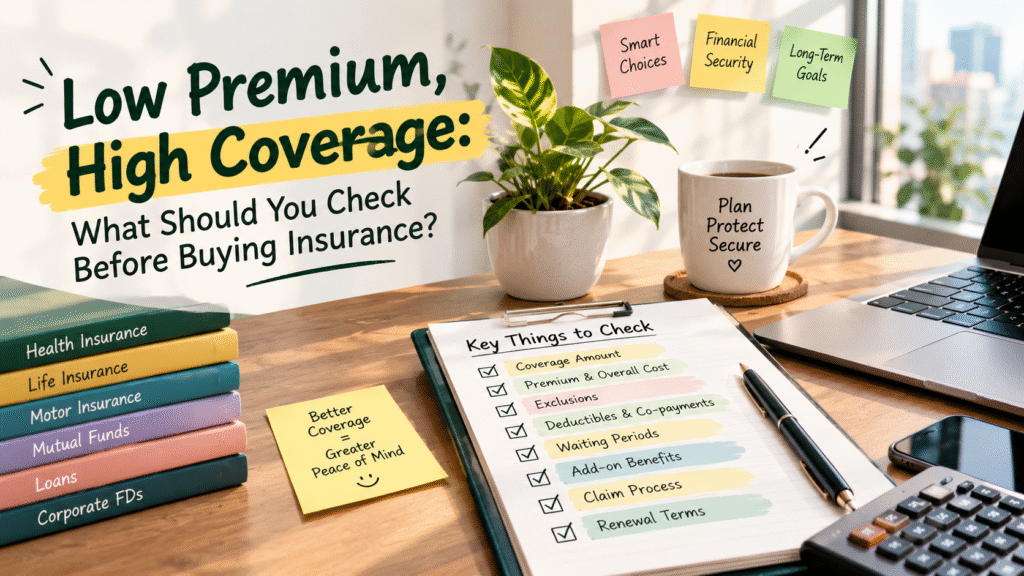
Buying insurance is one of those financial decisions that often looks simple until you start comparing plans. A policy with a low premium and high coverage may seem like the perfect deal, but the real value depends on what the policy actually covers, its exclusions, claim conditions, and other important details. Before choosing low premium, high coverage insurance, it is essential to look beyond the price and understand whether the policy will provide meaningful financial protection when you need it most.
Whether you are purchasing health, life, motor, or another type of insurance, the goal should be the same: protect yourself and your family without paying unnecessarily high premiums or compromising on essential benefits. Here is what you should check before making your decision.
Why Low Premium, High Coverage Insurance Needs Careful Evaluation
A lower premium does not automatically mean a better insurance policy. Insurers calculate premiums based on several factors, including your age, health condition, coverage amount, policy duration, location, and selected benefits.
Two policies may offer the same sum insured but provide very different levels of protection. One might include useful benefits and fewer restrictions, while another could have significant exclusions, waiting periods, or additional costs.
For example, a health insurance policy may advertise a high sum insured but include room-rent limits or co-payment requirements. These conditions could increase your out-of-pocket expenses during a hospitalisation.
That is why comparing the premium alone is not enough. You should understand what you are buying, what is included, and what you may need to pay yourself.
1. Check the Coverage Amount Before Buying Insurance
The first thing to evaluate is whether the coverage amount is sufficient for your needs.
A policy with a large coverage amount may look attractive, but the appropriate amount depends on your financial responsibilities and the risks you want to protect against.
For health insurance
Medical expenses can vary considerably depending on the hospital, treatment, city, and severity of the illness. When choosing health insurance, consider:
Your family’s medical history and healthcare requirements.
Hospitalisation and treatment costs in your city.
Whether you need individual or family floater coverage.
Existing employer-provided health insurance.
Your ability to pay unexpected medical expenses.
For life insurance
If you have dependants, outstanding loans, or long-term family responsibilities, your life insurance coverage should reflect those needs.
Consider your family’s regular expenses, future education costs, outstanding liabilities, and the financial support they may require if your income is no longer available.
The right coverage is not necessarily the cheapest option or the policy with the biggest advertised number. It is the amount that reasonably matches your financial responsibilities.
2. Read the Policy Exclusions Carefully
Exclusions are situations, treatments, or events that an insurance policy does not cover. They are among the most important details to review before purchasing any plan.
Advertisements usually focus on benefits, but exclusions explain where your protection may stop.
For example, health insurance policies may exclude certain treatments, impose waiting periods for specific conditions, or restrict coverage under particular circumstances. Motor insurance policies may not cover routine wear and tear or damage falling outside the policy’s terms.
Before buying, ask yourself:
Which situations are excluded from coverage?
Are there waiting periods before particular benefits become available?
Are there restrictions on specific treatments or events?
Does the policy require additional cover for risks that matter to me?
Read the policy wording and Customer Information Sheet wherever applicable. If a condition is unclear, ask the insurer or authorised intermediary for a written explanation.
Understanding exclusions in advance can help prevent unpleasant surprises when you file a claim.
3. Compare Deductibles, Co-Payments, and Other Limits
A low premium can sometimes come with conditions that require you to share more of the financial burden.
What is a deductible?
A deductible is an amount you must pay according to the policy terms before the insurer pays the eligible portion of a claim. Deductibles are common in certain motor and health insurance products.
What is co-payment?
A co-payment is the specified share of an eligible claim that you must pay yourself. For example, if a policy has a 10% co-payment and an eligible claim is ₹1,00,000, your share would generally be ₹10,000, with the insurer paying the remaining eligible amount, subject to policy terms and limits.
Why do these conditions matter?
Suppose two health insurance plans offer similar coverage, but one has a higher co-payment or deductible. The second plan might charge a lower premium, yet leave you with higher expenses during a claim.
Check room-rent limits, disease-specific sub-limits, deductibles, co-payments, and any other financial restrictions. Choose a structure you can comfortably manage if an unexpected event occurs.
4. Understand the Difference Between Base Cover and Add-On Benefits
Insurance policies often offer optional benefits, commonly known as add-ons or riders. These can enhance protection, but they may increase the premium.
In health insurance, additional benefits may include coverage enhancements, claim-related benefits, or specific medical protections. In motor insurance, options such as zero depreciation, roadside assistance, and engine protection may be available, depending on the insurer and product.
Before selecting an add-on, consider:
What exactly does the benefit cover?
Is it already included in the base policy?
Does it have separate limits, exclusions, or eligibility conditions?
How much additional premium does it cost?
Is the benefit relevant to your actual needs?
Do not assume that every advertised benefit is included in the basic policy. Compare the inclusions and exclusions of each plan to understand the real difference.
5. Evaluate the Insurance Company’s Claim Process
Insurance is valuable when it provides financial support during a difficult situation. Therefore, understanding the claims process is just as important as comparing premiums.
Before purchasing a policy, check the insurer’s claim submission procedure, required documents, support channels, and expected processing requirements.
For health insurance, find out whether the policy offers cashless treatment at suitable network hospitals and understand how reimbursement claims work.
For motor insurance, review the process for reporting an accident, arranging inspections, submitting documents, and obtaining claim approval.
You can also examine the insurer’s claim-related disclosures and grievance information. Claim settlement figures should be interpreted carefully because they may relate to different products, periods, or calculation methods.
A smooth claim experience depends on several factors, including the policy terms, accurate disclosure, complete documentation, and the circumstances of the claim. No insurer can guarantee approval of every claim.
6. Check Waiting Periods and Policy Conditions
Waiting periods determine how long you may need to wait before certain benefits become available. They are particularly important in health insurance.
Depending on the policy, waiting periods may apply to pre-existing diseases, specified illnesses, or particular procedures. Some benefits may be available immediately, while others become available only after the applicable waiting period.
When comparing plans, check:
The initial waiting period, where applicable.
The waiting period for pre-existing diseases.
Waiting periods for specified illnesses and procedures.
Conditions for renewing the policy.
Continuity benefits when porting an eligible policy.
Always disclose relevant information accurately when applying for insurance. Incorrect or incomplete disclosures can affect underwriting and claims, depending on the circumstances and applicable rules.
7. Look Beyond the First-Year Premium
A policy that is affordable today should also make sense for your future budget.
Premiums can change because of factors such as age, changes in coverage, applicable taxes, product pricing revisions, and policy-specific conditions. Renewal premiums are not necessarily the same as the amount you paid initially.
When evaluating a policy, review the premium schedule and renewal terms, where applicable. Understand whether the quoted amount includes all applicable charges and whether optional benefits have been added.
For life insurance, pay particular attention to the policy duration, premium payment term, coverage period, and whether the premium is guaranteed under the contract.
For health insurance, consider whether the plan can continue to meet your needs as your healthcare requirements change.
The aim is to choose protection that remains practical over time, rather than focusing only on the lowest initial price.
8. Compare Policies Using the Same Coverage Requirements
Comparing insurance plans becomes much easier when you evaluate similar features side by side.
Instead of choosing the cheapest quote immediately, create a simple comparison checklist.
| What to compare | What to check |
|---|---|
| Premium | Total cost and applicable charges |
| Coverage amount | Whether it meets your needs |
| Exclusions | Situations that are not covered |
| Deductibles and limits | Potential out-of-pocket expenses |
| Waiting periods | When specific benefits become available |
| Add-on benefits | Whether they are included or optional |
| Claims process | Procedures, documents, and support |
| Renewal terms | Conditions for continued protection |
Use the same coverage amount and comparable benefits wherever possible. This helps you identify whether a lower premium reflects genuine value or comes with limitations that may not suit your circumstances.
9. Avoid Common Mistakes When Buying Insurance
Even careful buyers can overlook important details when they are in a hurry to purchase a policy.
Here are some common mistakes to avoid:
Choosing price over protection: A cheap policy may not offer the benefits you actually need.
Ignoring policy wording: Important restrictions may be missed when you rely only on advertisements.
Buying unnecessary add-ons: Extra benefits should serve a clear purpose rather than simply increase the coverage list.
Providing incomplete information: Always disclose relevant details accurately.
Overlooking renewals: Understand renewal conditions and maintain coverage as required.
Assuming every claim will be paid: Claims are assessed according to the contract and applicable rules.
Taking a little extra time before buying can help you make a more informed decision and reduce the risk of unexpected expenses later.
How Growease Can Help You Make an Informed Insurance Decision
Choosing insurance should not feel like a confusing exercise in comparing numbers. It should be about understanding your risks, evaluating your options, and finding suitable protection within your budget.
At Growease Insurance Brokers Private Limited, the focus is on helping individuals and families understand insurance options and make informed financial decisions. By reviewing coverage requirements, policy features, exclusions, and costs, you can approach the buying process with greater clarity.
Before finalising any policy, make sure you understand the benefits, limitations, and conditions that apply to your chosen plan. If you need clarification, consult an appropriately authorised insurance professional.
Final Thoughts
Finding affordable insurance is important, but affordability should never come at the expense of essential protection. The best policy is not necessarily the one with the lowest premium or the highest advertised coverage. It is the one that offers suitable benefits, understandable terms, manageable costs, and protection aligned with your needs.
Before buying a policy, review the coverage amount, exclusions, deductibles, waiting periods, claim process, add-on benefits, and renewal conditions. Compare similar policies carefully and ask questions whenever something is unclear.
Ultimately, low premium, high coverage insurance should mean more than an attractive price. It should mean making a well-informed choice that helps protect your finances when life takes an unexpected turn.
Disclaimer: This article is for general educational purposes only and should not be treated as personalised financial or insurance advice. Coverage, exclusions, eligibility, premiums, and claim decisions depend on the specific policy wording and applicable regulations. Review the relevant documents before purchasing a policy.