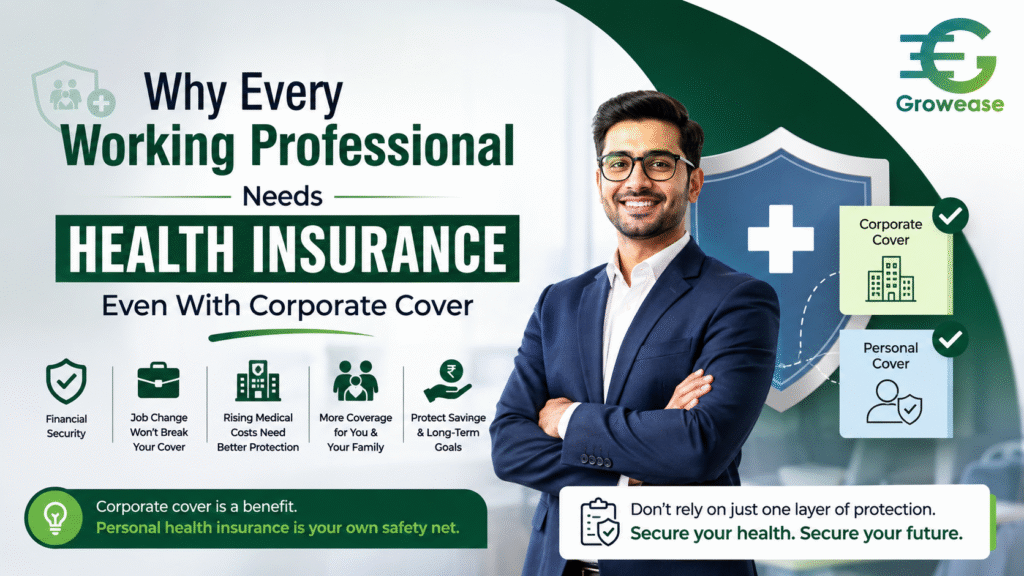
Having health insurance through your employer may feel like one less thing to worry about. After all, your company is already paying for a group health policy, so why spend extra money on another plan? But why every working professional needs health insurance even with corporate cover comes down to one simple reality: your employer-provided insurance is linked to your job, while personal health insurance is designed to protect you independently.
For a young professional, health insurance can easily feel unnecessary. You may be healthy, rarely visit a doctor, and assume that your corporate policy will take care of everything. However, medical costs can rise unexpectedly, and your employment situation can change just as quickly. A personal health insurance policy gives you an additional layer of financial protection when you need it most.
Why Every Working Professional Needs Health Insurance Even With Corporate Cover
Corporate health insurance is certainly valuable. It provides employees with coverage without requiring them to purchase a policy themselves, and in many cases, it also offers coverage for family members.
But corporate cover has limitations that are easy to overlook.
Your employer decides the sum insured, coverage conditions, network hospitals, room-rent limits, waiting periods, and other policy features. You generally have limited control over these terms. If you change jobs, take a career break, start a business, or retire, the corporate coverage may no longer be available to you.
A personal health insurance policy works differently. It stays with you regardless of where you work.
Corporate Health Insurance Is Linked to Your Employment
One of the biggest weaknesses of employer-sponsored health insurance is its connection to your job.
Imagine you have worked at the same company for several years and have never purchased personal health insurance because your employer already provides it. Then you decide to switch jobs. During the transition, you may temporarily have no health coverage or may need to wait until the new employer’s policy becomes active.
The same concern applies if you leave employment to start a business, take a sabbatical, become self-employed, or retire.
A personal policy provides continuity instead of making your health protection dependent on your employment status.
Why Corporate Health Cover May Not Be Enough for a Working Professional
Corporate insurance policies are usually designed to provide broad benefits to a large group of employees. However, the coverage may not always match your individual financial needs.
For example, your employer may provide a ₹3 lakh or ₹5 lakh sum insured. That might appear sufficient today, but a major hospitalization can quickly consume a significant portion of it.
Consider a situation where a family member requires surgery. Hospitalization, diagnostic tests, medicines, specialist consultations, room charges, and post-hospitalization expenses can add up quickly. If your corporate cover is insufficient, you may have to pay the remaining amount from your savings.
This is where personal health insurance can act as a second financial safety net.
Medical Costs Can Rise Faster Than Your Salary
Healthcare expenses have become an important financial concern for Indian households. Even routine medical procedures can be expensive, while major surgeries and prolonged hospitalizations can cost several lakhs.
Your income may increase gradually over the years, but medical expenses can create a sudden financial burden.
Having additional health insurance allows you to build protection before you actually need it rather than trying to arrange substantial funds during a medical emergency.
Personal Health Insurance Gives You Greater Control
One of the biggest advantages of buying your own policy is control.
With a personal health insurance plan, you can choose the sum insured according to your financial situation and expected healthcare needs. You can also compare insurers, coverage features, exclusions, deductibles, room-rent conditions, restoration benefits, and other policy features before making a decision.
Your employer’s policy may offer a standard package to everyone. A personal policy can be selected around your own requirements.
For example, a professional living in a metropolitan city may want a higher sum insured because private hospital costs can be considerably higher. Someone with dependent parents may also need to consider additional coverage for them.
You Can Choose Coverage Based on Your Life Stage
Your healthcare needs change as your life changes.
A young single professional may initially need individual coverage. Later, after marriage, they may want family floater coverage. As parents become older, separate policies or additional coverage may become increasingly important.
Building personal health insurance early gives you an opportunity to create a long-term protection strategy instead of making decisions only after a medical issue arises.
Why Every Working Professional Needs Health Insurance Even With Corporate Cover for Continuity
Insurance is not only about paying for today’s medical bills. It is also about protecting future insurability.
Buying a personal policy while you are young and relatively healthy can be beneficial because health conditions can change over time. Certain policies may have waiting periods for pre-existing diseases or specified treatments.
If you wait until you leave your job or develop a health problem, obtaining suitable coverage may become more complicated or expensive depending on the policy and your circumstances.
Personal coverage therefore creates a layer of continuity that your employer’s policy cannot necessarily provide.
Don’t Depend Entirely on Your Employer for Family Protection
Many professionals assume their corporate policy adequately covers their entire family. But the actual coverage depends on the employer’s policy terms.
Check:
- Who is covered under the corporate plan?
- What is the total sum insured?
- Is the cover shared among family members?
- Are parents included?
- What are the room-rent limits?
- Are there disease-specific sub-limits?
- What are the waiting periods?
- Which hospitals are part of the network?
- What happens to the coverage when you leave the company?
Reading these details can reveal gaps that may not be obvious when you simply know that you “have insurance.”
Personal Health Insurance Can Strengthen Your Financial Plan
A medical emergency can affect more than your health. It can also disrupt your savings and long-term financial goals.
Suppose you are investing through SIPs for a house, retirement, or your children’s education. If a large medical bill is not fully covered by your corporate policy, you may have to withdraw investments or use your emergency savings.
This can interrupt the compounding process and delay your financial goals.
A personal health insurance policy can help reduce the possibility of using investment money for unexpected hospitalization expenses.
Health Insurance and Your Emergency Fund Work Together
Health insurance and an emergency fund serve different purposes.
Your emergency fund can help with expenses such as temporary income loss, deductibles, transportation, medicines, or costs that insurance does not cover. Health insurance, meanwhile, is primarily designed to protect you against eligible healthcare expenses covered by the policy.
Having both creates a stronger financial safety net.
How Much Personal Health Insurance Should a Professional Consider?
There is no universal amount that works for everyone.
Your ideal coverage depends on factors such as your age, city, income, family size, existing corporate cover, lifestyle, medical history, and expected healthcare costs.
Instead of simply purchasing the cheapest policy, compare the coverage carefully. A higher sum insured can be useful, but the policy’s terms and exclusions are equally important.
You should also understand deductibles, co-payments, waiting periods, exclusions, claim procedures, and the insurer’s hospital network before purchasing.
What Should You Check Before Buying a Personal Policy?
Before choosing health insurance, don’t look only at the premium.
Consider:
- Sum insured: Is the coverage adequate for your location and family?
- Room-rent restrictions: Could these affect your claim?
- Waiting periods: Understand when specific treatments become eligible.
- Pre-existing conditions: Check how they are defined and covered.
- Network hospitals: Ensure convenient hospitals are available.
- Restoration benefits: Understand when and how coverage can be restored.
- Sub-limits and exclusions: Read these carefully.
- Claim process: Check how claims are handled and what documents are required.
- Renewability: Look for lifelong renewability where appropriate.
- Policy wording: Never rely only on advertisements or verbal explanations.
Why Every Working Professional Needs Health Insurance Even With Corporate Cover: The Bottom Line
Corporate health insurance is a useful employee benefit, but it should not necessarily be your only health protection.
Why every working professional needs health insurance even with corporate cover is ultimately about independence, continuity, and financial preparedness. Your job may change, your family may grow, medical expenses may increase, and your employer’s insurance terms may change.
A personal health insurance policy gives you control over an important part of your financial protection. Instead of waiting for a job change or medical emergency to expose a coverage gap, review your corporate policy today and identify what is missing.
Think of corporate insurance as one layer of protection—not the entire safety net.
At Growease, we believe financial planning is about preparing for both your goals and life’s unexpected moments. Along with investments, loans, and other financial solutions, choosing appropriate health insurance can help you protect the wealth you work hard to build.
Review your corporate cover, identify the gaps, and make your personal health protection part of your financial plan.