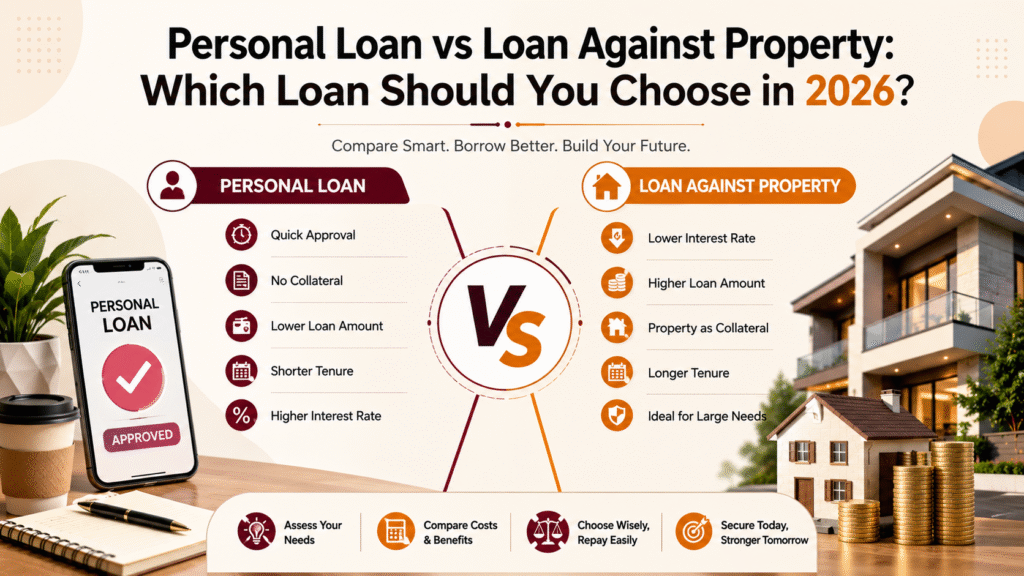
When you need funds for a major expense, choosing the right type of loan can significantly impact your financial health. Personal Loan vs Loan Against Property is one of the most common comparisons borrowers make because both options help meet financial needs but serve different purposes. Whether you’re planning a wedding, funding higher education, expanding your business, or handling a medical emergency, understanding the differences between these loans will help you make a smarter borrowing decision.
While both loans provide access to funds, they differ in eligibility, interest rates, repayment tenure, loan amount, and risk. This guide explains everything you need to know so you can confidently decide which loan best fits your financial goals.
What Is a Personal Loan?
A personal loan is an unsecured loan offered by banks and financial institutions without requiring any collateral. Since lenders do not ask for property or assets as security, approval primarily depends on your income, employment stability, credit score, and repayment history.
Personal loans are among the fastest financing options available today, making them ideal for urgent financial requirements.
Common Uses of a Personal Loan
- Medical emergencies
- Wedding expenses
- Home renovation
- Travel
- Higher education
- Debt consolidation
- Consumer durable purchases
Since there is no collateral involved, lenders usually charge a relatively higher interest rate compared to secured loans.
What Is a Loan Against Property?
A Loan Against Property (LAP) is a secured loan where you pledge your residential, commercial, or industrial property as collateral to borrow money.
The lender evaluates the market value of your property before deciding the eligible loan amount. Since the loan is backed by property, lenders generally offer lower interest rates and higher borrowing limits.
Common Uses of Loan Against Property
- Business expansion
- Higher education abroad
- Medical treatment
- Large home renovation
- Working capital requirements
- Debt refinancing
Borrowers continue to own and use the property while repaying the loan. However, failure to repay may allow the lender to take legal action against the pledged property.
Personal Loan vs Loan Against Property: Key Differences
Understanding Personal Loan vs Loan Against Property becomes easier when comparing their major features.
| Feature | Personal Loan | Loan Against Property |
|---|---|---|
| Type | Unsecured | Secured |
| Collateral | Not Required | Property Required |
| Interest Rate | Higher | Lower |
| Loan Amount | Moderate | High |
| Processing Time | Fast | Longer |
| Repayment Tenure | Usually up to 5-7 years | Can extend up to 15-20 years |
| Documentation | Simple | More extensive |
| Risk | No property risk | Property pledged as security |
Personal Loan vs Loan Against Property: Interest Rates
Interest rates play a significant role in determining your overall borrowing cost.
Personal Loan Interest Rates
Since personal loans are unsecured, lenders take on higher risk. As a result, interest rates are generally higher and depend on factors like:
- Credit score
- Income
- Employer profile
- Existing liabilities
Loan Against Property Interest Rates
Because the loan is secured by real estate, lenders usually offer lower interest rates. This reduces the overall repayment burden, especially for long-term borrowing.
If minimizing interest costs is your priority, Loan Against Property generally offers a financial advantage.
Loan Amount Comparison
One of the biggest differences lies in the maximum loan amount.
Personal Loan
The loan amount depends mainly on:
- Monthly income
- Credit profile
- Existing EMIs
- Employer category
Suitable for moderate financial needs.
Loan Against Property
The sanctioned amount depends on:
- Property market value
- Property type
- Borrower’s repayment capacity
Since lenders finance a percentage of the property’s value, borrowers can access substantially larger funds.
Processing Time and Documentation
Personal Loan
Personal loans usually involve:
- Basic KYC
- Income proof
- Bank statements
- Salary slips
Many lenders now provide digital approval, making the process quick and convenient.
Loan Against Property
Loan Against Property requires additional verification including:
- Property ownership documents
- Legal verification
- Technical valuation
- Income documents
- Identity proof
Because of property assessment, approval generally takes longer.
Repayment Tenure Comparison
Repayment flexibility affects monthly EMIs significantly.
Personal Loan
Shorter repayment tenure means:
- Higher monthly EMI
- Faster loan closure
- Less long-term commitment
Loan Against Property
Longer tenure provides:
- Lower monthly EMI
- Better cash flow management
- Comfortable repayment schedule
However, longer tenure may increase the total interest paid over time.
Advantages of Personal Loan
Quick Approval
Suitable for urgent funding requirements.
No Collateral
No need to mortgage any property.
Minimal Documentation
The application process is simple and convenient.
Flexible Usage
Funds can generally be used for almost any personal financial requirement.
Advantages of Loan Against Property
Lower Interest Rates
Secured nature makes borrowing more affordable.
Higher Loan Amount
Ideal for major financial commitments.
Longer Repayment Period
Helps reduce monthly EMI burden.
Continued Property Ownership
You retain ownership while repaying the loan.
When Should You Choose a Personal Loan?
A Personal Loan is generally suitable if:
- You need money urgently.
- You do not own property.
- Your funding requirement is relatively small.
- You want a simple and quick approval process.
- You have a strong credit score.
When Should You Choose a Loan Against Property?
A Loan Against Property may be a better choice if:
- You need a large amount of funding.
- You own eligible property.
- You want lower interest rates.
- You are comfortable pledging your property.
- You prefer longer repayment tenure.
Factors to Consider Before Choosing
Before selecting either loan, consider the following:
Purpose of Borrowing
Short-term expenses may suit a personal loan, while large investments often justify a loan against property.
Repayment Capacity
Choose an EMI that comfortably fits your monthly budget.
Credit Score
A higher credit score improves eligibility and may help secure better loan terms.
Loan Cost
Compare:
- Processing fees
- Interest rates
- Foreclosure charges
- Other applicable fees
Risk Appetite
If you’re uncomfortable pledging your property, a personal loan may be the safer option despite the higher interest rate.
Personal Loan vs Loan Against Property: Which One Is Better?
There is no one-size-fits-all answer. The right choice depends on your financial situation and borrowing needs.
Choose a Personal Loan if speed, convenience, and smaller funding requirements are your priorities.
Choose a Loan Against Property if you require a substantial loan amount, lower interest rates, and can comfortably offer property as collateral.
Always compare offers from multiple lenders, understand the repayment terms, and borrow only what you genuinely need.
Conclusion
The debate around Personal Loan vs Loan Against Property ultimately comes down to your financial objectives, repayment ability, and available assets. While personal loans offer quick access to funds without collateral, loans against property provide larger loan amounts at lower interest rates but require you to pledge your property.
Before making a decision, carefully evaluate your financial goals, compare loan features, and calculate the long-term repayment cost. Choosing the right loan can help you meet your financial needs without putting unnecessary strain on your finances.
At Growease, we help individuals compare loan options from trusted financial institutions and choose solutions that align with their financial goals. Our experts can guide you through the loan selection process, making borrowing simpler, smarter, and more transparent.