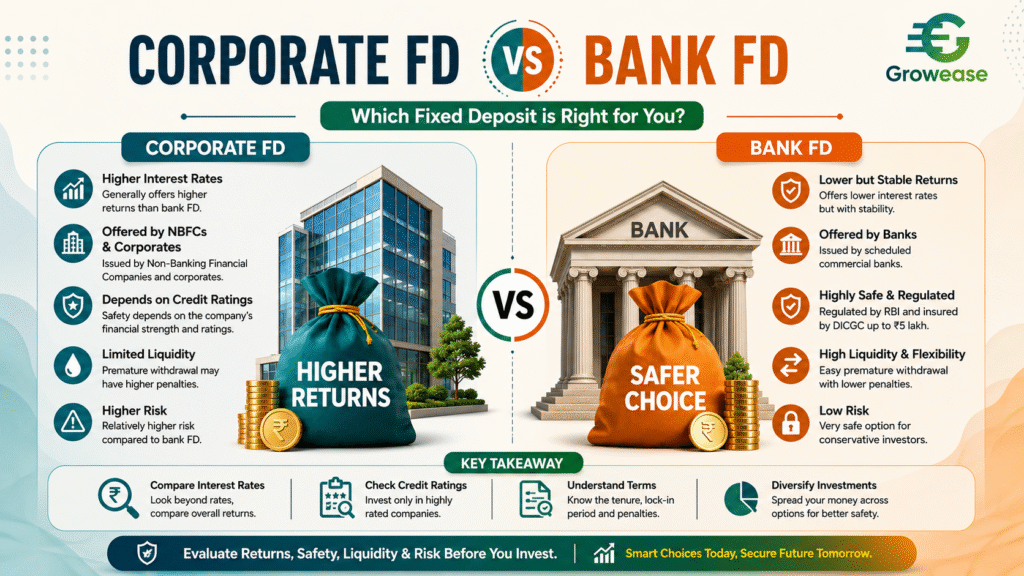
Choosing a safe investment option is one of the most important financial decisions for individuals who want stable returns without taking excessive risks. Corporate FD vs Bank FD is a common comparison among investors looking for fixed-income investment options. While both offer assured returns over a fixed tenure, they differ in terms of interest rates, safety, liquidity, taxation, and risk.
If you’re planning to invest your hard-earned money, understanding these differences can help you make an informed decision. In this guide, we’ll compare corporate fixed deposits and bank fixed deposits in detail, helping you determine which investment aligns best with your financial goals.
What is a Bank Fixed Deposit?
A Bank Fixed Deposit (Bank FD) is a savings instrument offered by banks where you deposit a lump sum amount for a fixed period and earn a predetermined rate of interest. The interest rate remains unchanged throughout the tenure, making it one of the safest investment options available.
Bank FDs are popular among conservative investors, retirees, and individuals who prioritize capital protection over higher returns.
Features of Bank Fixed Deposits
- Guaranteed returns
- Fixed interest rate throughout the tenure
- Flexible tenure ranging from 7 days to 10 years
- Premature withdrawal option (with penalty)
- Loan facility against the deposit
- Senior citizen interest rate benefits
- Deposit insurance up to ₹5 lakh per depositor per bank under DICGC
What is a Corporate Fixed Deposit?
A Corporate Fixed Deposit (Corporate FD) is a term deposit offered by Non-Banking Financial Companies (NBFCs), housing finance companies, and corporates. These deposits generally provide higher interest rates than bank FDs because they carry relatively higher risk.
Corporate FDs are suitable for investors willing to accept a moderate level of risk in exchange for better returns.
Features of Corporate Fixed Deposits
- Higher interest rates compared to most bank FDs
- Flexible investment tenures
- Monthly, quarterly, annual, or cumulative interest payout options
- Available through reputed companies and financial institutions
- Credit ratings indicate the safety level of the deposit
- Generally not covered under DICGC insurance
Corporate FD vs Bank FD: Understanding the Key Differences
Although both investment options appear similar on the surface, several important factors distinguish them.
1. Interest Rates
One of the biggest attractions of corporate fixed deposits is their higher interest rates.
- Bank FDs generally offer around 6%–7.75% annually, depending on the bank and tenure.
- Corporate FDs often provide returns ranging between 7%–9% or even higher for selected companies.
A higher interest rate can significantly improve your overall returns over longer investment periods.
2. Safety of Investment
Safety should always be the first consideration while investing.
Bank fixed deposits are considered one of the safest investment options because banks are regulated by the Reserve Bank of India (RBI), and deposits are insured up to ₹5 lakh under DICGC.
Corporate FDs, however, depend on the financial strength of the issuing company. If the company faces financial difficulties, repayment may be delayed or, in rare cases, default.
This is why checking the company’s credit rating is essential before investing.
3. Credit Ratings Matter
Unlike bank FDs, corporate deposits should never be selected solely based on interest rates.
Always look for credit ratings assigned by agencies such as:
- CRISIL
- ICRA
- CARE Ratings
- India Ratings
Higher-rated deposits generally indicate stronger repayment capability.
Common ratings include:
- AAA – Highest safety
- AA – High safety
- A – Adequate safety
- BBB – Moderate safety
Investors should generally prefer highly rated corporate deposits.
4. Liquidity and Premature Withdrawal
Unexpected expenses can arise anytime.
Bank FDs usually allow premature withdrawal with a small penalty.
Corporate FDs may have:
- Lock-in periods
- Withdrawal restrictions
- Higher penalties
- Different policies depending on the company
If liquidity is a priority, bank FDs often offer greater flexibility.
5. Risk Level
Every investment carries some level of risk.
Bank FDs involve minimal risk because of strong regulation and deposit insurance.
Corporate FDs carry credit risk, meaning repayment depends on the company’s financial health.
Higher returns always come with relatively higher risk.
6. Taxation
The taxation rules are largely similar for both investment options.
Interest earned is taxable according to the investor’s income tax slab.
If the interest exceeds the prescribed threshold, Tax Deducted at Source (TDS) may apply as per prevailing income tax rules.
Investors should also report interest income while filing their income tax returns.
7. Investment Tenure
Both options provide flexibility in tenure.
Typical investment periods include:
- Short-term (1–12 months)
- Medium-term (1–5 years)
- Long-term (5–10 years)
The ideal tenure depends on your financial objectives, future expenses, and cash flow requirements.
Who Should Invest in a Bank FD?
Bank fixed deposits are ideal for:
- First-time investors
- Senior citizens
- Retirees
- Emergency fund allocation
- Conservative investors
- Individuals seeking guaranteed returns
- Investors who prioritize capital protection
They are particularly useful for preserving wealth while earning stable interest.
Corporate FD vs Bank FD: Who Should Invest in Corporate FDs?
Corporate fixed deposits may be suitable for:
- Investors seeking higher returns
- Individuals with diversified portfolios
- Investors who understand credit risk
- Those willing to invest after evaluating company ratings
- Long-term investors looking to improve overall fixed-income returns
However, experts generally recommend avoiding investing all your fixed-income allocation in a single corporate deposit.
Diversification remains important.
How to Choose the Right Fixed Deposit
Before investing, evaluate these important factors:
Compare Interest Rates
Don’t simply choose the highest interest rate. Compare returns with the company’s financial strength.
Check Credit Ratings
Always invest in deposits with strong ratings from reputed agencies.
Understand Withdrawal Rules
Read the terms related to premature withdrawal, penalties, and lock-in periods.
Assess Financial Goals
Consider whether you need:
- Regular monthly income
- Quarterly payouts
- Annual interest
- Wealth creation through cumulative deposits
Choose the payout option that matches your financial needs.
Diversify Investments
Instead of putting your entire savings into one deposit, consider splitting your investment across multiple institutions and investment products.
Diversification reduces overall portfolio risk.
Common Mistakes Investors Should Avoid
Many investors unknowingly make mistakes while selecting fixed deposits.
Avoid these common errors:
- Investing solely for higher interest rates
- Ignoring company credit ratings
- Not reading withdrawal conditions
- Investing all savings in one company
- Forgetting tax implications
- Choosing an unsuitable tenure
- Ignoring liquidity requirements
Making informed decisions can help protect both your capital and returns.
Final Thoughts
When comparing fixed-income investments, there is no universal winner. The right choice depends on your financial goals, risk tolerance, and investment horizon.
If safety, liquidity, and guaranteed returns are your priorities, a bank fixed deposit remains an excellent option.
If you’re comfortable taking a measured amount of additional risk in exchange for potentially higher returns, investing in highly rated corporate fixed deposits may help improve your overall portfolio performance.
Before making any investment decision, evaluate interest rates, company credibility, credit ratings, taxation, and liquidity. A balanced approach that aligns with your financial objectives can help you build long-term financial stability.
Need expert guidance in choosing the right fixed-income investment? Growease can help you compare Corporate Fixed Deposits, Bank Fixed Deposits, Mutual Funds, Insurance, and other investment solutions to build a portfolio tailored to your financial goals.