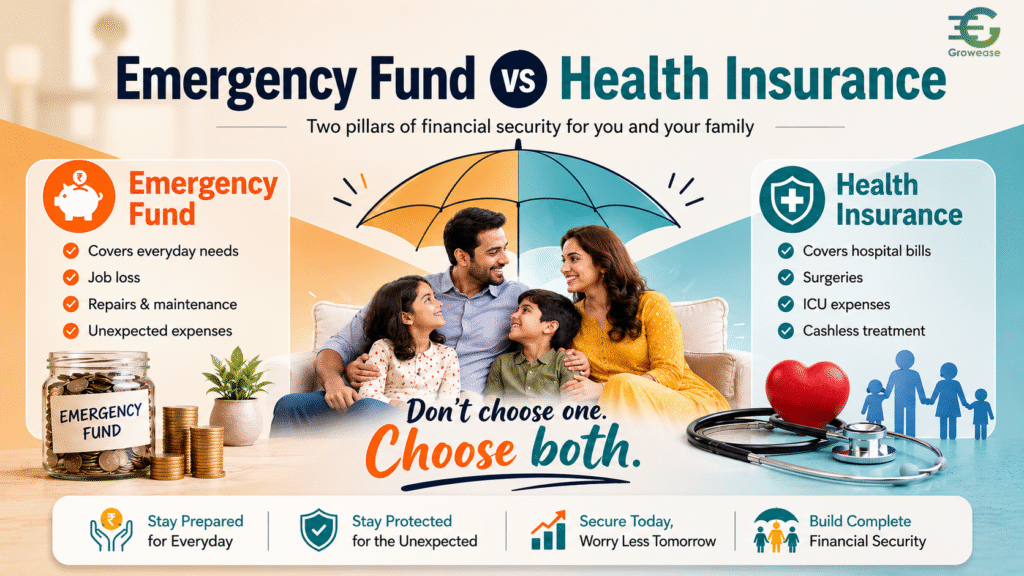
Financial planning is not just about growing your wealth—it is equally about protecting it. The debate around Emergency Fund vs Health Insurance often leaves people wondering which one deserves priority. While both serve as financial safety nets, they are designed for entirely different purposes. An emergency fund helps you manage everyday financial shocks, whereas health insurance protects you from the burden of high medical expenses.
If you are building a strong financial future, understanding the difference between these two essential tools can help you avoid financial stress and make smarter money decisions.
What Is an Emergency Fund?
An emergency fund is a dedicated savings reserve set aside for unexpected financial situations. It is meant to cover expenses that arise suddenly and cannot be postponed.
Examples include:
- Temporary job loss
- Major vehicle repairs
- Home maintenance emergencies
- Unexpected travel due to family emergencies
- Urgent household expenses
The purpose of an emergency fund is to provide immediate liquidity without forcing you to borrow money, use credit cards, or liquidate your investments.
How Much Should You Save?
Financial experts generally recommend saving between three and six months’ worth of essential living expenses. Individuals with irregular income or self-employed professionals may consider building a larger emergency reserve.
For example:
- Monthly essential expenses: ₹40,000
- Recommended emergency fund: ₹1,20,000 to ₹2,40,000
Keep this money in easily accessible options such as:
- High-interest savings accounts
- Sweep-in bank accounts
- Liquid mutual funds
- Short-term fixed deposits
Accessibility is more important than earning high returns.
What Is Health Insurance?
Health insurance is a financial protection plan that pays for eligible medical expenses when you require hospitalization or specified treatments.
Instead of using your personal savings to pay expensive hospital bills, the insurer covers the expenses according to the policy terms and coverage.
Health insurance generally covers:
- Hospitalization expenses
- Surgeries
- ICU charges
- Daycare procedures
- Pre- and post-hospitalization expenses
- Cashless treatment at network hospitals
- Ambulance expenses (depending on the policy)
Medical inflation continues to rise every year, making quality health insurance one of the most important financial products for every family.
Emergency Fund vs Health Insurance: Understanding the Difference
Although both provide financial protection, they solve different problems.
| Feature | Emergency Fund | Health Insurance |
|---|---|---|
| Purpose | Covers financial emergencies | Covers medical expenses |
| Source | Personal savings | Insurance company |
| Accessibility | Immediate | During eligible medical claims |
| Covers hospital bills | No | Yes |
| Covers daily emergencies | Yes | No |
| Risk of depletion | Yes | No, subject to policy coverage |
Understanding these distinctions helps you allocate your money wisely instead of choosing one over the other.
Why an Emergency Fund Alone Is Not Enough
Many people believe that having substantial savings is sufficient. However, a single major hospitalization can consume years of disciplined savings.
Imagine this situation:
- Emergency savings: ₹2,00,000
- Hospital bill: ₹8,50,000
Without adequate health insurance, your emergency savings would disappear quickly, and you might still need loans or borrow from family members to pay the remaining amount.
Medical emergencies are unpredictable, and treatment costs can increase rapidly due to surgeries, ICU care, diagnostic tests, and prolonged hospitalization.
Why Health Insurance Alone Is Not Enough
Health insurance offers excellent medical protection, but it cannot solve every financial challenge.
Suppose:
- Your car requires urgent repairs.
- You lose your job unexpectedly.
- Your home needs immediate electrical work.
- A family emergency requires urgent travel.
Health insurance will not pay for these situations because they are not medical claims.
Without emergency savings, you may end up relying on high-interest personal loans or credit cards, creating unnecessary financial pressure.
Why You Need Both for Complete Financial Protection
Instead of comparing one against the other, think of them as partners.
An emergency fund manages life’s everyday financial surprises, while health insurance protects your long-term savings from expensive healthcare costs.
Together they provide:
- Better financial stability
- Lower dependence on debt
- Protection against medical inflation
- Peace of mind during emergencies
- Greater confidence in long-term financial planning
Using both strategies together creates a stronger financial foundation for individuals and families.
How to Build an Emergency Fund
Starting an emergency fund does not require a large amount of money.
Here are practical steps:
1. Set a Savings Target
Calculate your monthly essential expenses and multiply them by at least three.
2. Automate Monthly Savings
Set up an automatic transfer every month immediately after receiving your salary.
3. Keep the Money Separate
Maintain a dedicated account that is used only for genuine emergencies.
4. Avoid Using It for Lifestyle Expenses
Vacations, shopping, gadgets, and festivals should not be funded using emergency savings.
5. Rebuild After Every Withdrawal
If you use part of your emergency fund, replenish it as soon as possible.
How to Choose the Right Health Insurance
Buying the cheapest policy is not always the best decision.
Consider the following factors:
Adequate Sum Insured
Choose coverage that matches current medical costs in your city.
Wide Hospital Network
A larger cashless hospital network makes treatment more convenient.
Low Waiting Period
Compare waiting periods for pre-existing illnesses and specific treatments.
Claim Settlement Record
Select insurers known for efficient and reliable claim processing.
Additional Benefits
Look for features such as:
- No Claim Bonus
- Annual health check-ups
- Restoration benefits
- Daycare treatment coverage
- OPD benefits (where available)
Review your policy every few years to ensure it still meets your family’s healthcare needs.
Common Mistakes People Make
Avoid these financial planning mistakes:
- Depending only on savings for medical emergencies
- Buying health insurance with inadequate coverage
- Ignoring rising healthcare costs
- Spending the emergency fund on non-essential purchases
- Delaying financial planning until a crisis occurs
Planning early is always less expensive than reacting during an emergency.
Final Thoughts
Strong financial security is built by preparing for both expected and unexpected challenges. Savings help you handle everyday financial disruptions, while health insurance protects you from the rising cost of medical treatment.
Rather than choosing between the two, create a financial plan that includes both. This balanced approach helps protect your income, preserve your savings, and gives your family greater financial confidence during difficult times.
At Growease, we help individuals and families choose suitable health insurance plans while also supporting broader financial planning through mutual funds, loans, and corporate fixed deposits. Building the right financial safety net today can make all the difference tomorrow.