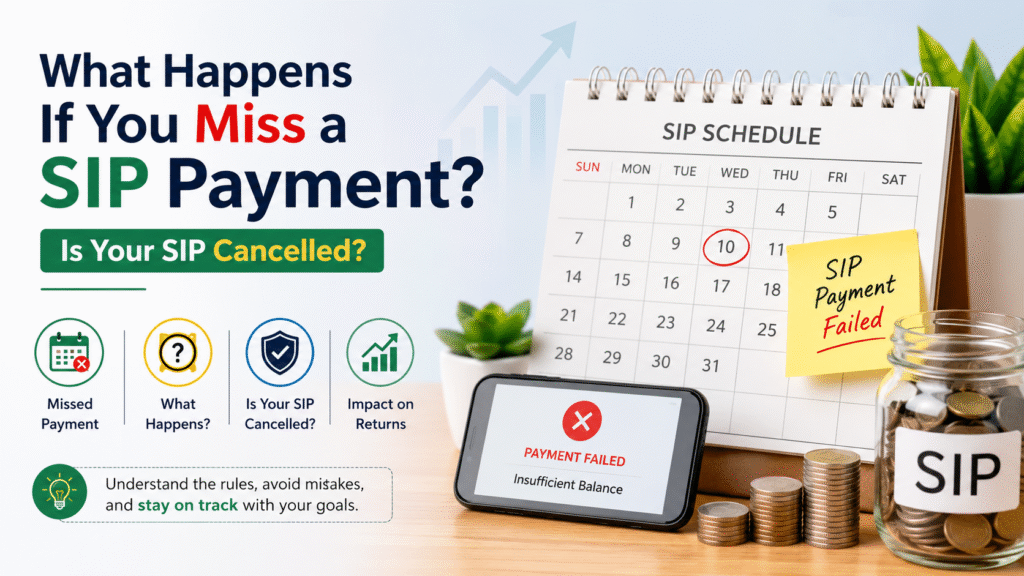
Starting a Systematic Investment Plan (SIP) is one of the simplest ways to build an investment habit. You choose an amount, set a date, and your money gets invested regularly in a mutual fund. But life doesn’t always go according to plan. A salary may arrive late, your account balance may be low, or you may simply forget about an upcoming auto-debit. So, what happens if you miss a SIP payment? Does your SIP get cancelled? Is there a penalty? Will you lose your previous investments?
The good news is that missing one SIP installment generally does not mean that your entire mutual fund investment is cancelled. However, there are a few important things every investor should understand.
What Happens If You Miss a SIP Payment?
A SIP is essentially a method of investing a fixed amount into a mutual fund at regular intervals. Unlike a loan EMI, a SIP installment is not generally a mandatory payment that you must make every month.
If your SIP installment is missed because your bank account does not have sufficient funds, the scheduled investment simply may not happen for that particular installment.
For example, suppose you have a monthly SIP of ₹5,000 scheduled for the 10th of every month. If your account doesn’t have enough balance on that date, the transaction may fail. Your existing mutual fund units remain invested, but the ₹5,000 for that particular month is not invested.
Your next scheduled SIP installment can generally continue as usual, provided the SIP mandate remains active and there are no other issues with the mandate or account.
Does Missing One SIP Stop Your Investment?
Not necessarily.
Missing a single installment usually does not automatically cancel your SIP. Your previous investments continue to remain in your mutual fund scheme, and future installments may continue according to your existing SIP instructions.
This is one reason investors shouldn’t panic after missing one payment.
However, repeated failed installments can become a problem, depending on the mutual fund house, payment method, and applicable mandate rules.
Will Your SIP Be Cancelled If You Miss a Payment?
This is one of the most common concerns among new investors.
A single missed SIP installment does not normally mean that your entire SIP is cancelled. The consequences can depend on the number of consecutive failed installments and the terms applicable to your SIP and payment mandate.
Some mutual fund platforms or AMCs may discontinue a SIP after repeated failed transactions according to their applicable rules.
So, don’t confuse missing an installment with cancelling a SIP.
When you miss one installment, you haven’t necessarily told the mutual fund company that you want to stop investing. You have simply failed to complete one scheduled investment.
What Happens to Your Previous SIP Investments?
Your previous investments don’t disappear because you missed a new installment.
Suppose you invested ₹5,000 every month for one year and accumulated mutual fund units worth ₹60,000, subject to market movements. If your next SIP installment fails, those existing units continue to remain invested.
Their value will continue to fluctuate based on the performance of the underlying securities and the mutual fund scheme.
The missed installment simply means that you didn’t purchase additional units for that particular cycle.
Is There a Penalty for Missing a SIP Payment?
There isn’t a universal penalty imposed simply because you didn’t invest your SIP amount.
However, if your SIP payment is processed through an auto-debit mandate and the transaction fails due to insufficient funds or another banking issue, your bank or payment service provider may charge a transaction or mandate-related fee.
The exact charges can vary between banks, payment providers, and circumstances.
For this reason, it’s worth checking your bank statement and the applicable terms if your SIP payment has failed.
Also remember that a SIP is an investment, not a loan repayment. Missing a SIP installment is therefore different from missing an EMI, where late-payment charges and other consequences can apply under the loan agreement.
What Happens If Your SIP Auto-Debit Fails?
Auto-debit is one of the reasons SIPs are so convenient. You don’t have to manually transfer money every month.
But convenience comes with one small responsibility: maintaining sufficient funds in your account around the scheduled debit date.
An auto-debit can fail because of:
- Insufficient account balance
- Incorrect or expired mandate
- Bank-related technical issues
- Problems with the payment instruction
- Changes to your bank account
- Mandate-related restrictions
If your SIP auto-debit fails, the investment for that particular installment may not take place.
Should You Manually Invest After a Failed SIP?
You can consider making a separate investment if you still want to invest that month’s intended amount and the mutual fund scheme/platform allows it.
However, you don’t necessarily need to invest twice in the following month just because you missed one SIP.
A SIP is designed to encourage disciplined investing over time. Missing one installment is generally less important than maintaining a sustainable investment habit over the long term.
Does Missing a SIP Affect Your Returns?
Missing a SIP can affect your potential long-term returns, but the impact depends on several factors.
When you skip an installment, that amount is not invested during that particular period. Therefore, you don’t get the potential market exposure that the missed investment could have provided.
For example, imagine you normally invest ₹5,000 every month. If you miss one installment, ₹5,000 remains outside the investment for that month. If markets subsequently rise, you won’t benefit from the potential growth that investment might have generated.
On the other hand, if markets fall after the missed installment, investing later could potentially mean buying units at a lower price.
This illustrates an important point: market returns cannot be predicted, so investors shouldn’t try to time the market based on individual missed installments.
The bigger advantage of SIP investing is consistency over a long investment horizon rather than worrying about one particular month.
What Should You Do If You Miss a SIP Payment?
If you’ve missed an installment, don’t panic. Instead, follow a few simple steps.
1. Check Why the Payment Failed
Look at your bank account and SIP transaction status. Determine whether the issue was insufficient balance, a mandate problem, or another technical reason.
2. Check Whether Your SIP Is Still Active
Log into your mutual fund platform or contact the relevant AMC/platform to confirm that future SIP installments are still scheduled.
3. Decide Whether You Want to Invest the Missed Amount
If your financial situation allows and you still want to invest the amount, you can consider making a separate investment rather than waiting for the next scheduled installment.
4. Maintain Sufficient Balance Before the Next Date
If your SIP uses auto-debit, keeping the required amount in your bank account before the scheduled date can help prevent another failed transaction.
5. Don’t Stop Your Long-Term Plan Because of One Missed Installment
A missed SIP doesn’t mean your investment strategy has failed.
Financial journeys aren’t always perfect. What matters is getting back on track and continuing according to your financial goals.
Can You Pause a SIP Instead of Missing Payments?
Yes, investors may have options to pause or modify their SIP depending on the mutual fund, AMC, platform, and applicable rules.
If you know in advance that you won’t be able to invest for a few months, exploring the available pause or modification facility may be better than repeatedly allowing auto-debits to fail.
For example, if you’re facing a temporary cash-flow issue, you might consider reducing the SIP amount or pausing it temporarily if the relevant facility is available.
However, such decisions should be based on your financial situation and investment objectives rather than short-term market movements.
How to Avoid Missing SIP Payments
The easiest way to avoid missed installments is to make your SIP fit comfortably within your monthly budget.
Here are a few practical habits:
- Keep your SIP date close to your salary credit date.
- Maintain sufficient balance in your bank account.
- Review your active SIP mandates periodically.
- Increase your SIP gradually as your income grows.
- Keep an emergency fund for unexpected expenses.
- Review your investments when your financial goals or income change.
Most importantly, don’t choose a SIP amount simply because someone else is investing that much. Your SIP should be comfortable enough to continue through both good and difficult months.
What Happens If You Miss a SIP Payment Repeatedly?
One missed installment is usually not a reason for concern. Repeated failures, however, deserve attention.
If multiple consecutive SIP transactions fail, the SIP may eventually be discontinued according to the applicable AMC, mandate, or platform rules.
Repeated failures may also indicate that your current SIP amount isn’t aligned with your cash flow.
Instead of repeatedly missing payments, consider reviewing your monthly budget and deciding whether the SIP amount needs to be adjusted.
Final Takeaway
So, what happens if you miss a SIP payment? In most cases, one missed installment does not wipe out your existing investments or automatically cancel your entire SIP. Your previous mutual fund units remain invested, while the missed installment simply means that you didn’t make that particular investment.
The important thing is not to panic or make an impulsive investment decision because of one missed payment. Check the reason for the failure, confirm that your SIP remains active, and continue investing according to your financial plan.
SIP investing is ultimately about building a long-term habit. You don’t need a perfect investment journey—you need a consistent and realistic one.
If you’re unsure how much you should invest through SIPs, which mutual fund categories may suit your goals, or how to structure your overall investment plan, professional financial guidance can help you make decisions based on your goals, risk profile, and investment horizon.
Growease can help you approach investing with a goal-oriented strategy rather than simply investing because a particular fund o